Potentiometer Codes Explained: B103, B10K, A10K & More
Author: David Marriott, Spectra Symbol CEO
If you see B103, A10K, B10K, or 103 on a potentiometer, you might expect each marking to have a tidy, universal meaning. Potentiometer markings, however, aren't quite that polite.
In most cases, the marking tells you the potentiometer's nominal resistance and, sometimes, its taper.
But potentiometer codes aren't completely standardized. The same letter can mean different things from one manufacturer or product family to another. So use the marking as a starting point, then check the manufacturer's documentation before designing around a part or ordering a replacement.
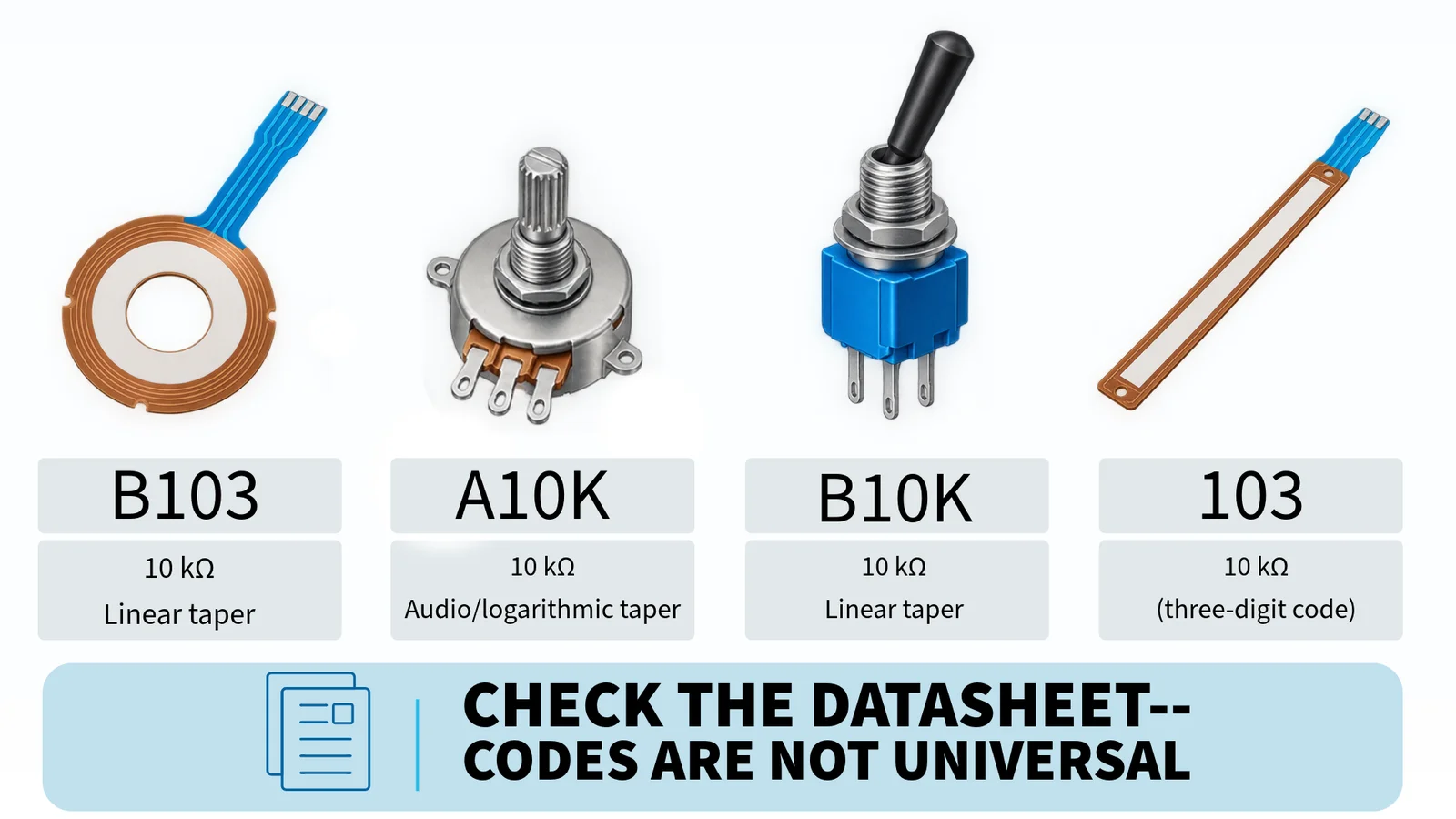
The basic rule is straightforward:
- The number tells you the nominal resistance.
- A letter may tell you the taper.
- The meaning of that letter depends on the manufacturer's coding system.
Think of the marking as a useful clue—not the whole specification.
Code Chart
| Marking | Usual Meaning | Notes |
|---|---|---|
| B103 | Linear taper, 10 kΩ | Common in many Asian-manufactured parts |
| A10K | Audio/logarithmic taper, 10 kΩ | Common in Alpha-style and many hobbyist/audio pots |
| B10K | Linear taper, 10 kΩ | Common in Alpha-style parts |
| 103 | 10 kΩ | Three-digit resistance code |
| 104 | 100 kΩ | 10 × 10⁴ |
| 502 | 5 kΩ | 50 × 10² |
| A | Often audio/logarithmic | Can mean linear in some European systems |
| B | Often linear | Can mean audio/logarithmic in some European systems |
| C | Often reverse-audio/reverse-log | Manufacturer-dependent |
What Does B103 Mean on a Potentiometer?
Let's break it down.
B103 contains two pieces of information:
- B = linear taper, under the common A/B coding convention
- 103 = 10 kΩ resistance
The resistance portion is the easy part:
10 × 10³ = 10,000 Ω = 10 kΩ
So if you're looking at a potentiometer marked B103, the common interpretation is:
10 kΩ potentiometer with a linear taper.
That's why B103 shows up so often in searches for rotary and panel potentiometers.
What Do A10K and B10K Mean?
This is where potentiometer markings can get confusing.
In many Alpha-style and hobbyist potentiometers:
- A10K = 10 kΩ, audio/logarithmic taper
- B10K = 10 kΩ, linear taper
The 10K portion identifies the nominal resistance. The A or B identifies the taper under that particular coding convention.
So two potentiometers can both be rated at 10 kΩ and still behave very differently as you turn the shaft.
What Is the Three-Digit Resistance Code?
You will often see potentiometers marked with a three-digit number instead of—or in addition to—something like "10K."
The basic calculation is:
First two digits = significant figures
Third digit = multiplier, or number of zeros
So:
- 103 → 10 × 10³ = 10,000 Ω = 10 kΩ
- 104 → 10 × 10⁴ = 100,000 Ω = 100 kΩ
- 502 → 50 × 10² = 5,000 Ω = 5 kΩ
- 101 → 10 × 10¹ = 100 Ω
So when you see 103, think:
10, followed by three zeros.
That gives you 10 kΩ.
This three-digit format is also commonly seen on resistors, which is why the notation may look familiar. Just remember that a marking by itself is not a substitute for identifying the actual component.
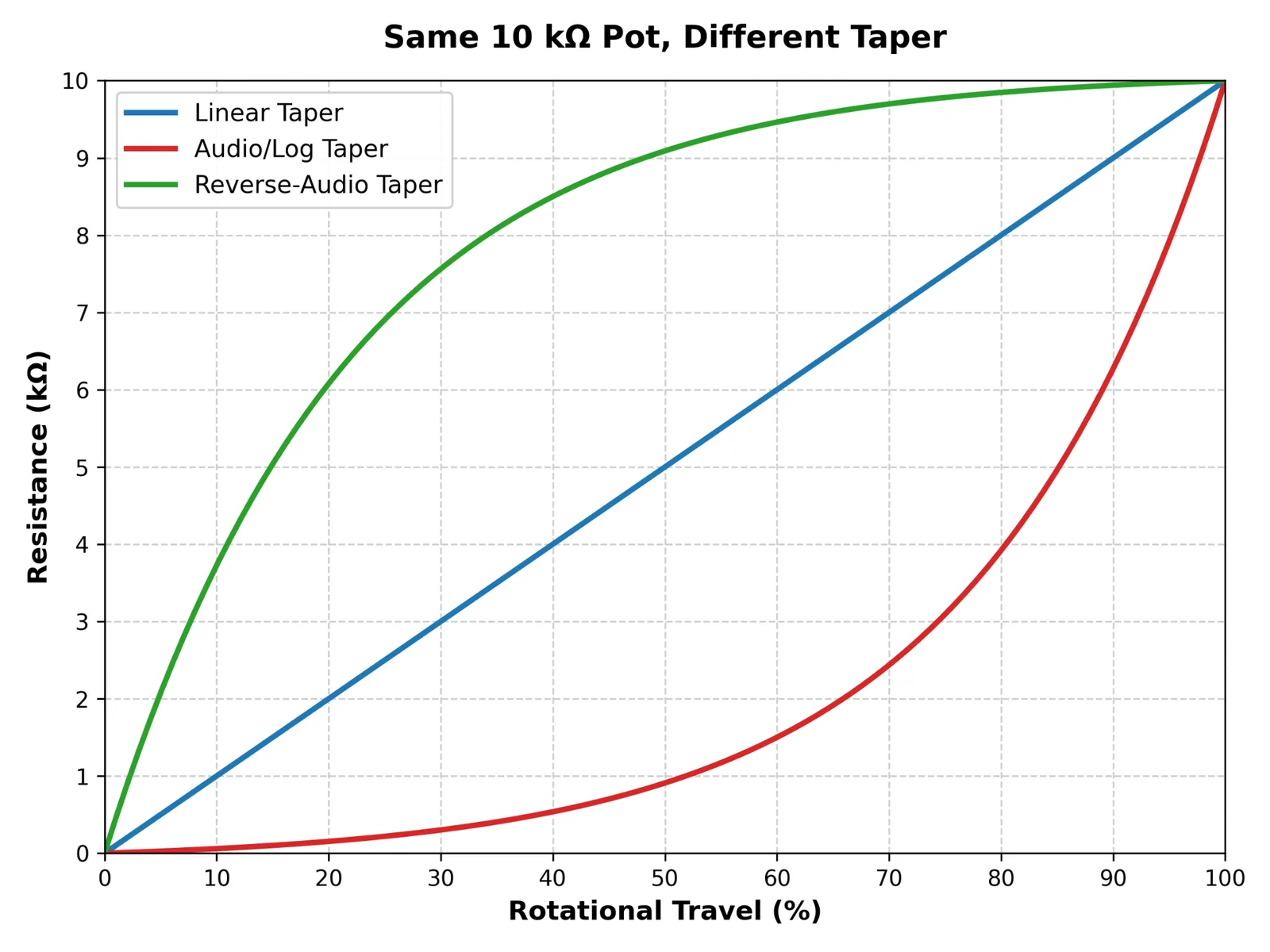
What Is Potentiometer Taper?
Resistance value tells you how much resistance the potentiometer has.
Taper tells you how that resistance changes as you move the wiper.
That distinction is especially important when the potentiometer is being used as a position sensor or voltage divider.
Linear taper
With a linear taper, the resistance changes approximately in proportion to wiper position.
Move the wiper halfway through its electrical travel, and you're approximately halfway through the resistance range.
That's useful when you want the electrical output to track physical position in a predictable way.
Audio or logarithmic taper
An audio taper changes resistance nonlinearly.
It's commonly used for audio volume controls because human perception of loudness isn't linear. The changing resistance curve can therefore produce a more natural-feeling volume control.
Reverse-audio or reverse-log taper
This uses the opposite type of nonlinear response.
Modified or S-taper
Some potentiometers use shaped curves that don't follow a simple linear or logarithmic relationship.
So when you see a taper designation, don't think of it as a minor detail. It describes the behavior of the potentiometer.
Why taper matters for position sensing
If you're measuring physical position, you generally want the electrical output to correspond predictably to that physical position.
That's why linear taper is normally the appropriate choice for position measurement.
A 10 kΩ audio-taper potentiometer is still 10 kΩ. But halfway through its mechanical travel does not necessarily correspond to half of its resistance.
Same resistance value. Different behavior.
That's one of the easiest mistakes to make when replacing a potentiometer.
Common Potentiometer Values and Typical Uses
Potentiometers are available in a wide range of resistance values. Here are some common ones:
| Value | Common Applications | General Consideration |
|---|---|---|
| 1 kΩ | Low-impedance circuits, some sensor interfaces | Higher current, generally less susceptible to loading/noise from high source impedance |
| 5 kΩ | General controls, some audio and sensor applications | Moderate source impedance |
| 10 kΩ | Microcontrollers, general controls, position sensing | Common general-purpose value |
| 50 kΩ | Higher-impedance circuits, some audio applications | Lower current draw |
| 100 kΩ | High-impedance, low-current applications | Higher source impedance can matter |
| 500 kΩ | Specialized high-impedance circuits | Pay attention to noise and ADC settling |
10 kΩ is a particularly common value, including in many applications involving position sensing and microcontrollers.
Spectra Symbol's membrane potentiometers commonly use 10 kΩ, with longer active lengths above 300 mm using 20 kΩ in some product configurations. Those products also have their own specified resistance tolerance, so the nominal resistance should not be confused with the resistance you will necessarily measure on an individual part.
The important point is that there isn't one universally correct potentiometer resistance.
The circuit determines what makes sense.
Why Does the Actual Resistance Value Matter?
It's easy to look at a potentiometer marking and think the only question is whether it says 10K, 50K, or 100K.
In an actual circuit, the resistance value affects several things.
Tolerance
A potentiometer marked 10 kΩ has a nominal resistance of 10 kΩ.
That does not necessarily mean you'll measure exactly 10,000 Ω.
For example, a potentiometer with a ±20% tolerance could measure approximately:
10 kΩ × 0.80 = 8 kΩ
to
10 kΩ × 1.20 = 12 kΩ
The specified tolerance for the actual part is what matters.
Ratiometric measurement
When a potentiometer is used as a voltage divider, the circuit often cares more about the ratio than the absolute resistance.
For example, if the potentiometer is connected across a reference voltage and the wiper is used as the output, the output voltage depends on the wiper's position relative to the total resistance.
That's one reason a relatively large resistance tolerance can be acceptable in many position-sensing applications.
Source impedance and ADC settling
Resistance value also affects the impedance seen by an analog-to-digital converter.
As resistance increases, the source impedance can increase. That can affect how quickly the ADC's internal sampling capacitor charges and therefore how much acquisition time the converter needs.
This is device-dependent. Don't assume that 10 kΩ is automatically the correct maximum or minimum for every ADC.
Current and power
A lower-resistance potentiometer generally allows more current to flow when connected across a voltage supply.
That means more power can be dissipated in the resistive element.
A higher-resistance potentiometer reduces current draw, but it also increases source impedance.
So there's a tradeoff.
Noise
Higher source impedance can also make a circuit more susceptible to electrical noise and other leakage effects.
Again, the right value depends on the application.
What Do Potentiometer Lug or Terminal Numbers Mean?
A typical three-terminal potentiometer has:
- Terminal 1 and Terminal 3: the two ends of the resistive element
- Terminal 2: the wiper
The exact physical orientation of those terminals depends on the component and how you're looking at it, so don't assume that terminal 1 is always physically on the left.
For diagrams and wiring examples, see our guide to:
Potentiometer Wiring and Pinout
If you're unsure which terminal is which, a multimeter can also tell you what you're looking at.
How to Verify a Potentiometer Marking With a Multimeter
If the marking isn't clear—or you're about to replace an important part—it's worth checking the potentiometer rather than guessing.
1. Measure the total resistance
Set your multimeter to resistance mode.
Measure between the two outer terminals.
You should get a value close to the potentiometer's marked nominal resistance, within the specified tolerance.
2. Check the wiper
Measure between the wiper and one outer terminal.
Slowly rotate the shaft or move the slider through its electrical travel.
The resistance should change as the wiper moves.
3. Look at the way it changes
A linear potentiometer should change relatively steadily through its travel.
An audio-taper potentiometer will change much more gradually through one part of the travel and much more rapidly through another.
If the resistance jumps around, goes open, or has dead spots, you may be looking at a damaged or worn potentiometer rather than simply a different taper.
For the complete procedure, see How to Test a Potentiometer.
Replacing a Potentiometer? Match More Than the Resistance
If you're replacing a potentiometer, finding the same resistance value is a good start.
It isn't enough by itself.
Check:
- Resistance value
- Taper
- Tolerance
- Power rating
- Electrical travel or rotation
- Number of turns
- Terminal configuration
- Mechanical dimensions
- Shaft or actuator configuration
- Environmental requirements
This is particularly important when you're replacing a position sensor.
A replacement can have the same 10 kΩ resistance and still produce the wrong output because the taper, electrical travel, mechanical dimensions, or terminal configuration is different.
In other words:
Match the behavior, not just the number.
Frequently Asked Questions
What is the value of the 103 potentiometer?
What is a B-type potentiometer?
What does B10K mean?
Is B103 linear or audio taper?
What does A10K mean?
Does 103 always mean 10 kΩ?
The One Rule to Remember
If there's one thing to take away from potentiometer markings, make it this:
Treat the marking as a clue, not a complete specification.
The number tells you the nominal resistance.
The letter may tell you the taper—according to that manufacturer's coding system.
And when the exact behavior or replacement matters, the datasheet is the tie-breaker.
That's the difference between finding a potentiometer that looks like the right replacement and finding one that actually behaves the way your circuit needs it to.
When you need a particular form factor, travel length, or membrane construction, Spectra Symbol offers linear position sensors and SoftPot membrane potentiometers in standard and custom resistance values.