Thin and Flexible Potentiometers
Author: David Marriott, Spectra Symbol CEO
When you’re designing in tight spaces, every millimeter matters. From robotics to medical devices, today’s electronics pack more into smaller enclosures. For design engineers working under strict space, weight, and mechanical constraints, traditional rotary sensors often aren’t an option.
These are the kinds of challenges where thin and flexible potentiometers come in handy. Instead of reworking your layout to make room for bulky hardware, you can use a sensor that adapts to the space you have. In the sections below, we’ll look at key specs, real-world applications, and frequently asked questions for Spectra Symbol’s ThinPot™ and SoftPot™ sensors.
How Does a Potentiometer Work?
A potentiometer functions as a variable resistor or voltage divider, consisting of a resistive track and a movable wiper. How does a potentiometer work? As the wiper slides along the track, it changes the resistance ratio to produce a voltage output that corresponds precisely to the wiper’s physical position, allowing for accurate tracking in electronic systems.
The Advantage of Thin and Flexible Potentiometers
Thin and flexible potentiometers streamline this technology by printing the resistive element onto a membrane, effectively eliminating bulky mechanical shafts and housings. This allows the sensor to remain ultra-thin and conform to curved surfaces, providing reliable position feedback in spaces where rigid components simply cannot fit.
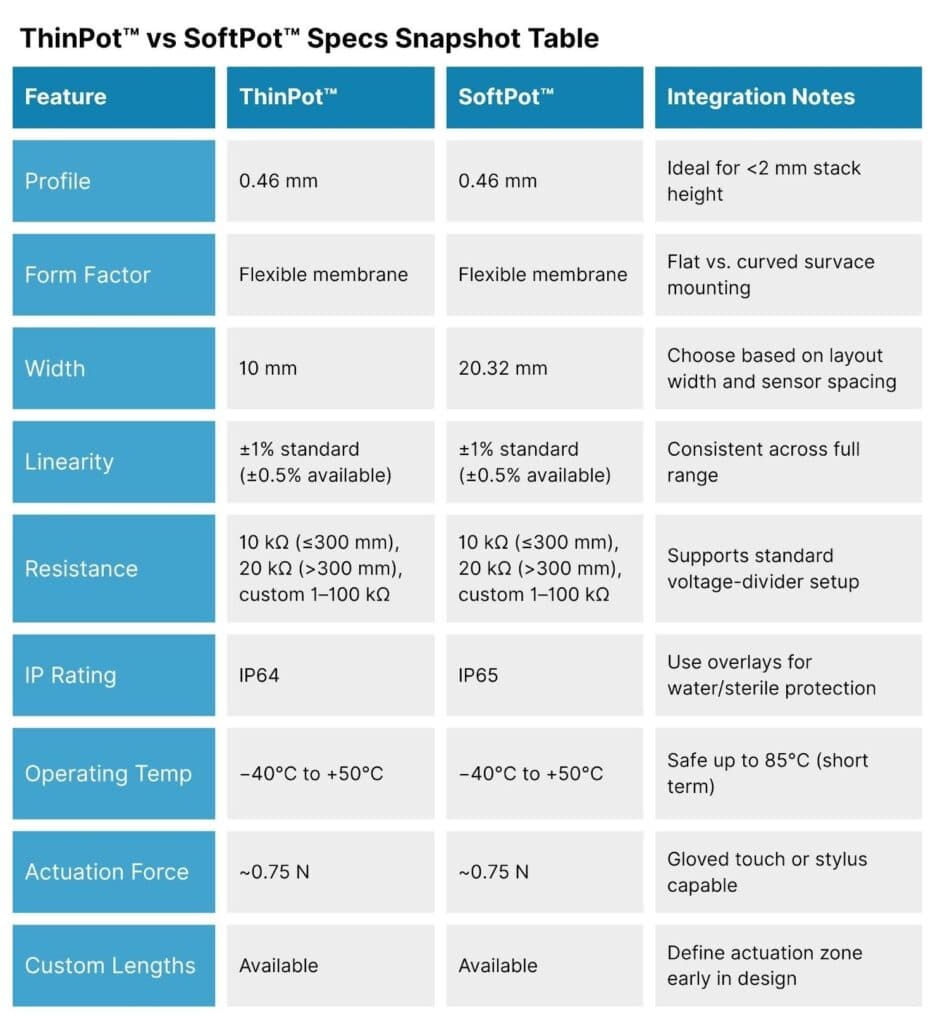
Comparison at a Glance: ThinPot™ vs SoftPot™
Both sensors offer reliable linear feedback in a thin form factor, but the better fit depends on your layout and application. This quick overview highlights the specifications and integration details to help you compare.
Real-World Applications for Thin and Flexible Potentiometers
The numbers tell one story—but the real impact of ThinPot™ and SoftPot™ comes to life in the hands of engineers facing complex challenges. Here are some use-case examples where engineers are applying Spectra Symbol’s sensors to overcome those challenges.
Medical Imaging Equipment
Thin SoftPot sensors are used in imaging equipment like MRIs and CT scanners to ensure precise position sensing and accurate diagnosis.
High-Performance Vehicle Systems
In high-performance vehicle systems, Thin SoftPot sensors are used to monitor piston positions in real time. This helps optimize suspension and handling systems in racing applications.
Rangefinder Binoculars
The cylindrically shaped SoftPot sensors are integrated into the focus dial of rangefinder binoculars. This allows the dial to be converted to a digital dial and to provide electronic feedback for the binocular’s advanced features.
Electrical Interface
- Voltage Divider: Standard 3-wire configuration (Vcc, GND, Signal)
- Touch-to-Activate: Signal is only active when actuated
- Ratiometric Output: Varies proportionally with input voltage
- Filtering Tips: Add a low-pass filter to smooth signal output
- Idle State Handling: Use pull-down resistor for known inactive state
Microcontroller Compatibility
- Works with 3.3V and 5V logic (Arduino, STM32, TI, etc.)
- Recommended analog pin input, with optional averaging/filtering
Mechanical Integration
- Mounting Options: Pressure-sensitive adhesive backing (standard), optional screw tabs
- Bend Radius: SoftPot minimum 25 mm in non-active region
- Electrical Travel: Electrical travel is 10 mm shorter than sensor length; leave a 5 mm margin at each end in your mechanical design
- Connector Support: Secure tail and cable in high-vibration designs
Recommended Connector Types
- ZIF (0.5mm and 1.0mm pitch), FFC/FPC, Solder Tabs, Nicomatic/Berg
- Example: Molex 52207-0660 (6-pin), Nicomatic 14106-14 (5-pin)
Thin & Flexible Potentiometers: Frequently Asked Questions
Still wondering about resistance ranges, temperature ratings, or microcontroller compatibility? We’ve compiled answers to the most frequently asked questions from design engineers below.
General Use & Applications
1. What’s the difference between ThinPot™ and SoftPot™?
2. How thin are these sensors, exactly?
3. What applications are they best suited for?
• SoftPot: Medical devices, curved enclosures, and research instrumentation
4. What are the lead times and minimum orders for custom sensors?
5. Can SoftPots be cut or trimmed to length?
Technical & Electrical
1. What resistance values are available?
2. What’s the linearity tolerance?
3. What actuation force is required?
4. Are they compatible with 3.3V microcontrollers?
5. Can I use these with microcontrollers?
Integration & Customization
1. Can I customize the length or actuation area?
2. What connector options are available?
3. Can I use them in sterilized devices?
Conclusion: Designed for the Demands of Modern Engineering
When you find yourself in a pinch, where your space is too narrow, curved, or unique for a traditional potentiometer, Spectra Symbol offers helpful solutions. Whether you’re prototyping an aerospace component, refining a surgical tool, or working on high-performance vehicles, these flexible, ultra-thin sensors are built to meet modern engineering needs.
Have a tight space, curved surface, or custom sensor requirement?
Check out the datasheets for Spectra Symbol’s ThinPot™ and SoftPot™ sensors or get in touch to talk about customizing a solution that fits your design.