Single-Turn vs. Multi-Turn Potentiometers: What's the Difference?
Author: David Marriott, Spectra Symbol CEO
Imagine two potentiometers with the same total electrical range. One spans that range in a single turn; the other spreads it across ten. The second gives you more shaft rotation to work with, so each small movement changes the setting less. That's the central trade-off behind multi-turn adjustment—and the reason it can be useful for calibration and fine-tuning.
In this guide, we'll compare single-turn and multi-turn potentiometers, look at how turn count affects adjustment, and explain where trimpots fit into the picture. We'll also cover what to consider when choosing a turn count, when a single-turn potentiometer is enough, and what to look for if your application needs nearly 360° of rotary sensing or continuous rotation.
Single-turn vs. multi-turn potentiometers: the basic difference
The main difference between a single-turn and a multi-turn potentiometer is how many times the adjustment shaft turns to cover its operating range.
A single-turn potentiometer adjusts across its specified electrical travel in one partial or full rotation. A multi-turn potentiometer spreads its adjustment across several shaft rotations, allowing smaller changes in the setting with each turn.
That extra travel can make a multi-turn potentiometer easier to fine-tune when a small adjustment has a noticeable effect on a circuit's behavior. But it doesn't automatically provide a wider resistance range, greater accuracy, or better long-term stability. Those characteristics depend on the component's specifications and the surrounding circuit.
Multi-turn potentiometers are common in precision-adjustment applications, including calibration and circuit setup. Many are designed as trimmer potentiometers, or trimpots, which are adjusted during installation or maintenance rather than operated regularly by an end user.
Choosing between the two comes down to what you're adjusting, how finely you need to adjust it, and how often you'll need to make changes.
For the underlying mechanism and selection considerations, see Bourns' application note on multi-turn versus single-turn trimmers.
What does a multi-turn potentiometer actually give you?
The main advantage of a multi-turn potentiometer is finer manual adjustment. Because the wiper travels across the resistive element over several shaft rotations, each small turn can produce a smaller change in the setting than it would on a comparable single-turn design.
Consider a simplified example. Suppose two potentiometers cover the same electrical range:
- One covers that range over 300° of shaft rotation.
- The other covers it over 3,600°, or 10 full turns.
In this example, the 10-turn potentiometer spreads the same range over 12 times as much angular travel. That can make it easier to dial in a small adjustment without overshooting the desired setting.
However, 12 times the angular travel does not mean 12 times the accuracy. Actual performance depends on the component's specifications and the circuit in which it operates.
It's helpful to distinguish four concepts:
- Adjustment granularity: How finely you can change a setting.
- Accuracy: How closely a measured or adjusted value matches its intended value.
- Repeatability: How consistently you can return to the same setting.
- Stability: How well the setting or output holds over time and changing conditions.
A multi-turn mechanism can improve the experience of making a fine adjustment, but turn count alone does not establish the other performance characteristics. For more on selecting a trimmer for a particular application, see Bourns' multi-turn versus single-turn application note.
How many turns do you need?
Multi-turn potentiometers are available with different adjustment ranges. The right choice depends on how finely you need to adjust the setting, how often you change it, and the requirements of your application.
For example, Bourns offers several turn counts across its trimmer and precision-potentiometer families:
- 5-turn: The Bourns 3214 is a multi-turn trimmer.
- 10-turn: The Bourns 3590 series is a 10-turn precision potentiometer.
- 25-turn: The Bourns 3296 is a 25-turn trimmer.
These examples illustrate the variety available; they are not a universal ranking of which turn count is best.
More turns mean more shaft rotation to cover the adjustment range. That extra movement can be useful when a small change matters, but it may be unnecessary for a control that needs quick, broad adjustments.
When comparing components, look beyond the number of turns. Check the electrical specifications, mounting requirements, package, and intended application before choosing a replacement.
What is a trimpot, and how does it relate to multi-turn potentiometers?
A trimpot, short for trimmer potentiometer, is a potentiometer intended for trimming or calibration. It's commonly mounted on a circuit board and adjusted during setup, testing, or maintenance rather than used as a regular control.
The terms trimpot and multi-turn potentiometer describe different things. A trimpot describes the component's role and typical form factor; single-turn and multi-turn describe its adjustment mechanism.
That means a trimpot can be single-turn or multi-turn. And a multi-turn potentiometer can be designed for applications beyond board-level trimming.
A common example: the 3296 trimpot
The Bourns 3296 series is a 25-turn, through-hole trimmer with a resistance range of 10 Ω to 2 MΩ. Its datasheet also specifies an adjustment tool.
The 3296 is one example of a multi-turn trimpot, not a template for every trimmer. Other families differ in turn count, mounting style, resistance range, dimensions, and electrical characteristics.
If you're replacing a trimpot, identify the exact part number and consult its datasheet. A similar-looking component—or one with the same nominal resistance—may not be a suitable substitute.
When does a trimpot make sense?
A trimpot is a reasonable choice when a circuit needs an adjustable value set during calibration or setup, but that value isn't intended to be changed regularly by the end user.
For example, a technician might use one to adjust a circuit's operating point during testing. A panel-mounted potentiometer is generally a more natural fit when a person needs to change a setting frequently during normal operation.
The important distinction isn't simply whether one component has more turns. It's whether the component's design and adjustment mechanism fit the way the circuit will be used.
Trimpot pinouts and adjustment tools: what should you check?
Before installing or replacing a trimpot, verify its terminal arrangement and the way it connects to the circuit. Don't assume every trimmer uses the same physical pin layout just because it has three terminals.
A potentiometer commonly has two end terminals and a wiper, but the placement of those terminals depends on the component. Check the part's datasheet for the terminal diagram and confirm that its connections suit the intended circuit.
For a broader explanation of terminal functions and wiring, see Spectra Symbol's Potentiometer Wiring and Pinout Guide. To confirm which terminal is which on a part you already have, see How to Test a Potentiometer.
The adjustment tool matters, too. Some trimmers use a slotted adjustment screw, but slot dimensions and recommended tools vary by model. For example, the Bourns 3296 datasheet specifies the H-90 adjustment tool, while Bourns recommends different tools for certain other trimmer families.
Check the manufacturer's recommended tool for the specific component rather than assuming one screwdriver fits every trimpot. Don't assume all trimmers require a nonconductive tool, either; follow the component documentation and the safety requirements of the application.
Useful references include the Bourns 3296 datasheet and Bourns' adjustment-tool documentation.
If you're trying to identify a component's resistance value or taper, see the related guide to potentiometer markings and specifications rather than relying on appearance alone. Those details matter when selecting a replacement, but they are separate from turn count.
When don't you need a multi-turn potentiometer?
A multi-turn potentiometer isn't automatically the best choice whenever an application calls for precision. Sometimes a single-turn component provides all the adjustment a circuit needs, with less time spent turning the shaft across its range.
The key is to distinguish adjusting a value precisely from measuring a position precisely.
A multi-turn potentiometer can help someone make small manual changes to a setting. But if a system struggles to distinguish small changes in a sensor's output, adding more turns to a different potentiometer may not solve the problem.
Measurement performance depends on the entire system: the sensor, its electrical behavior, the signal-conditioning circuitry, noise, and—if the signal is digitized—the analog-to-digital converter (ADC). The ADC's nominal bit depth alone doesn't guarantee that every small input change can be measured accurately. See Microchip's explanation of ADC resolution and accuracy and Analog Devices' discussion of ADC input noise.
For position sensing, the right solution depends on how the position is measured and how the resulting signal is used. A multi-turn trimmer designed for circuit calibration is not necessarily the right sensor for tracking a moving part.
What if you need nearly 360° of rotary sensing—or continuous rotation?
Rotary potentiometers have specified travel limits. A component described as rotary shouldn't automatically be assumed to sense an entire 360° rotation, and a nearly full-circle sensing angle is not the same as endless rotation.
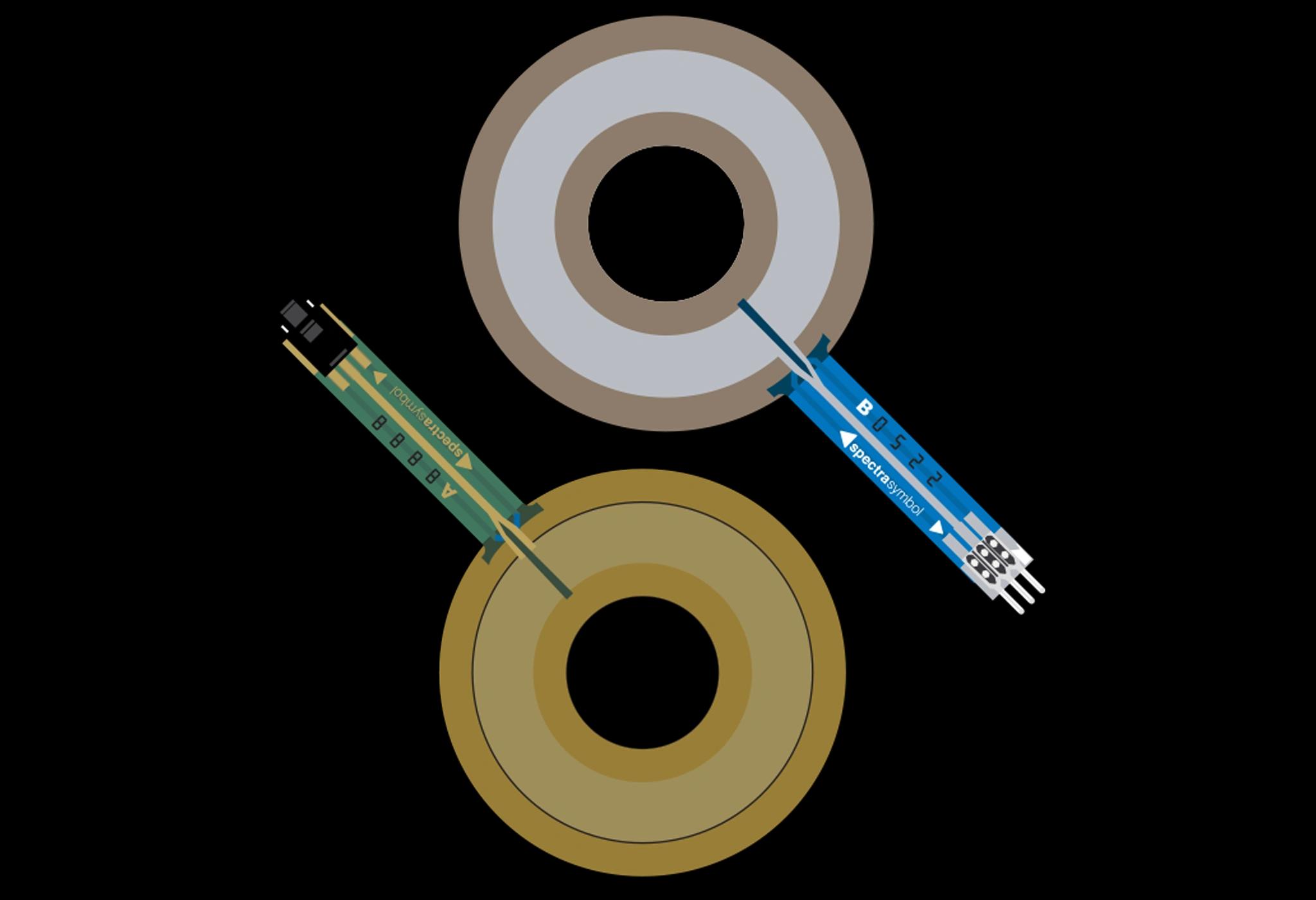
Spectra Symbol's SoftPot Rotary Potentiometer, for example, specifies a 353° active sensor angle. That means the sensor has an active sensing range of 353°; it does not mean it provides active sensing across a full 360° or can rotate endlessly.
If your application needs position feedback through repeated revolutions, consider whether a rotary potentiometer is the right sensing mechanism at all. A rotary encoder may be a better fit for some applications, depending on whether you need incremental or absolute position information and how the system will process that data.
For a more detailed comparison of the two approaches, see Spectra Symbol's guide to encoders vs. potentiometers.
Frequently asked questions
What is the difference between single turn and multi-turn potentiometers?
What is the name of a multi-turn potentiometer?
What are the four types of potentiometers?
How does a dual potentiometer work?
Choosing the right potentiometer
The choice between single-turn and multi-turn potentiometers comes down to the adjustment your application requires. Single-turn designs are useful for quick, broad changes; multi-turn designs spread the adjustment over more shaft travel, making fine manual tuning easier in suitable applications.
If you're considering a trimpot, verify the exact component specifications, pinout, mounting, and recommended adjustment tool. And if your real challenge is sensing position rather than setting a circuit value, consider whether a different sensing approach would be more appropriate.